Real Monasterio de San Lorenzo de El Escorial
Real Monasterio de San Lorenzo de El Escorial · Madrid
Por Spain ·
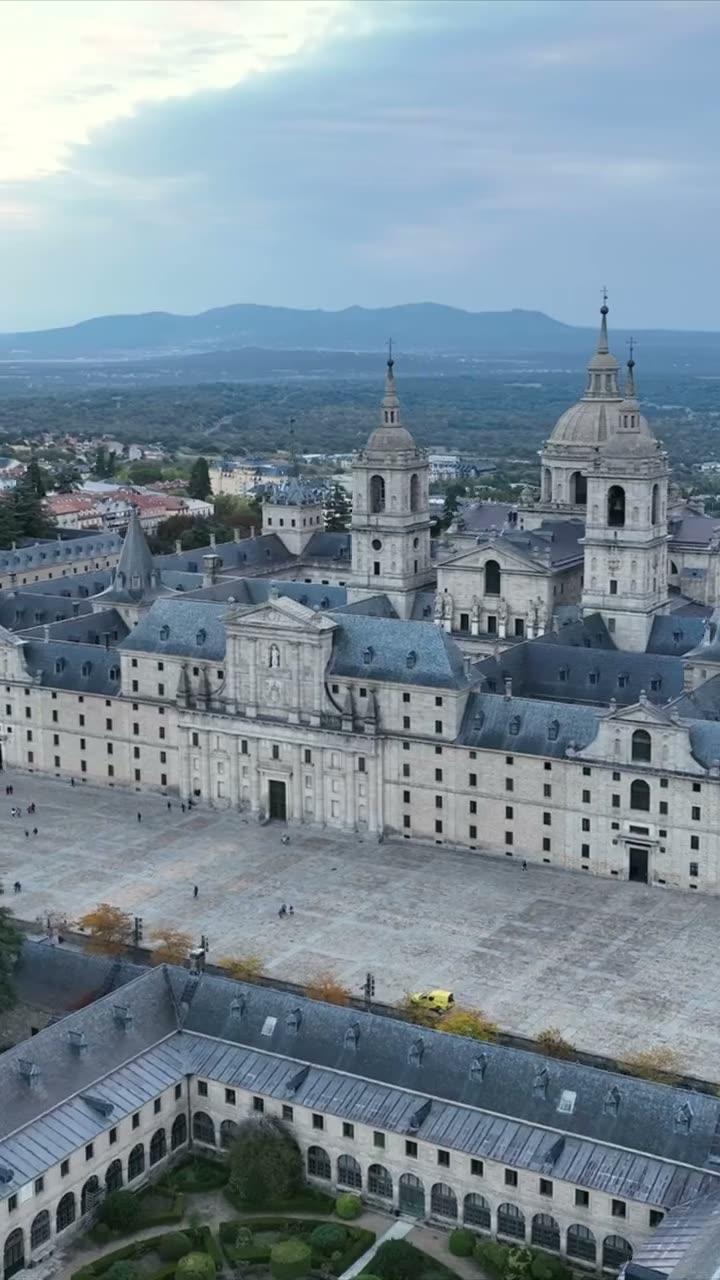
The Monastery of El Escorial gave rise to the Herrerian architectural style, under the guidance of its creator, Juan de Herrera. It has been designated a World Heritage Site.
Philip II used this Royal Site as a family mausoleum. Construction work began in 1563, under the supervision of Juan de Toledo. Following his death, Juan de Herrera took over the project, completing the building in 1584.
The building is constructed of granite and divided into three vertical sections, the central one being the Patio de los Reyes. Normal 0 21 false false false ES X-NONE X-NONE
At its corners stand four towers, each 55 metres high, topped with metal spheres. The building’s rooms include the Ministerios, the Casa de los Oficios, the Compaña, the Infantes and the Reina, which are connected by arches.
The church has a Greek cross plan and, in its chancel, stand the funerary monuments of Charles V and Philip II. Also worth mentioning is the library, on the second floor of the west façade, which houses around 45,000 printed works from the 15th and 16th centuries. In 1971 it was declared a Historic-Artistic Site and, in 1984, a World Heritage Site.
The architecture of this building, designed by Juan de Herrera, gave rise to the architectural style known as ‘Herrerian’. It is a vast complex, as evidenced by its 15 cloisters, 13 oratories, 86 staircases, 88 fountains, over 1,600 paintings, 9 towers and 73 sculptures.
The Monastery is also home to the Escolanía de El Escorial, one of Spain’s most important and long-established choirs. Founded in 1567 by order of Philip II, it comprises 45 child and young singers.
Museums of Painting and Architecture After being closed for ten years for renovation work, the Museums of Painting and Architecture at the Royal Monastery of San Lorenzo de El Escorial will reopen in 2026. To mark the reopening, both museums can be visited free of charge without the need to purchase a general admission ticket to the monastery until 31 December 2026.
The Museum of Painting displays around a hundred works by the great masters of the Italian, Flemish and Spanish schools, such as Titian, Tintoretto, Paolo Veronese, Van der Weyden, Luca Giordano and José de Ribera, amongst others.
The Museum of Architecture offers an insight into the key aspects of the monastery’s design and construction, which made this complex one of the great architectural projects of the Modern Age and established it as a benchmark both within and outside Spain.
More at spain.info
#patrimonio #monasterio #museo #visitspain
Comentarios
- jaime Martín bernad: El panteón de los reyes impresiona muchísimo.